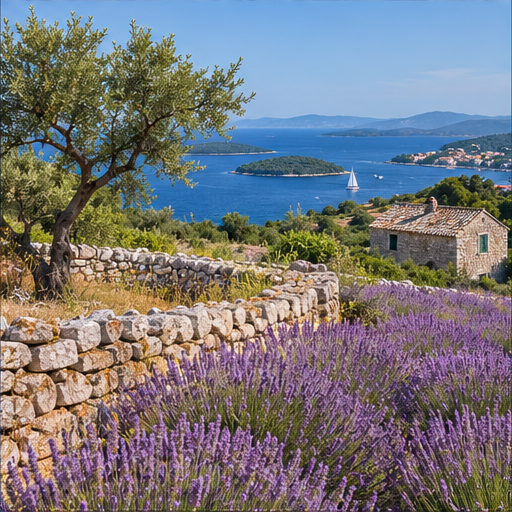
Hvar is an island of distinct centers rather than one continuous resort strip. Hvar Town faces the Pakleni Islands; Stari Grad sits deeper inside a sheltered bay; inland roads cross fields and settlements.
Hvar makes more sense when its towns are treated as separate centers. Hvar Town concentrates visitor energy around its harbor and hillside fortress. Stari Grad lies farther inside a protected bay and relates differently to the water. Between them, roads pass through settlements and cultivated land, making an island day a choice between coast, heritage and inland movement.
Start in Hvar Town without stopping at the harbor
The harbor is a natural arrival point, but continue into the town’s squares and lanes to see its civic scale. St Stephen’s Square opens the center toward the waterfront, while the hill above leads to Fortica. The climb is an active part of the visit; consider heat, footing and mobility before going up. The view across the harbor and islands makes the topography easier to grasp.
For a short stay, choose either a town walk with the fortress or a boat-oriented day toward nearby islands rather than trying to fit everything into a few hours. Boat services and conditions vary, so verify what operates on your date. A longer stay lets you divide experiences across days and keep evenings from becoming rushed transfers.
Give Stari Grad its own chapter
Stari Grad’s position at the end of a deep bay feels different from the island’s more exposed southern edge. The historic center is tied to the harbor and an agricultural hinterland. Nearby Stari Grad Plain is a cultural landscape whose field pattern reflects centuries of cultivation. It is a place to understand continuity in land use, not merely a scenic detour.
Walking or cycling in the plain requires planning: shade can be limited, and distances may feel greater in summer heat. Select a manageable route and bring water. If you have limited mobility, check surfaces and access conditions before setting out rather than assuming a rural walk is level.
Choose the inland route for atmosphere
The island’s interior gives a sense of distance from the water even though the coast is never far away. Roads link small communities and pass through fields, stone enclosures and Mediterranean vegetation. Lavender is part of the island’s agricultural imagery, but blooms are seasonal and cannot be assumed. Walls, slopes and cultivated plots remain worth noticing outside the flowering period.
A car offers flexibility for inland stops, while a bicycle suits travelers prepared for hills and heat. Public transport may serve some connections but should be checked for the season and day. Avoid building an itinerary around a precise service until confirmed. Choose between a focused town stay and a broader island circuit, not a race to touch every village.
Decide how much island you want
Hvar rewards travelers who can balance arrival, town walking and one additional landscape or coast experience. An overnight stay can make a route feel less dependent on a single boat connection, but exact options change. If pairing the island with Split, read our Split guide. For another harbor-town rhythm, see Rovinj’s peninsula walk.
Choose a base based on your days: Hvar Town for the harbor-facing scene and access to the Pakleni Islands; Stari Grad for a quieter bay setting and connection to the plain. The island can support both, but a thoughtful itinerary need not force both into every trip.