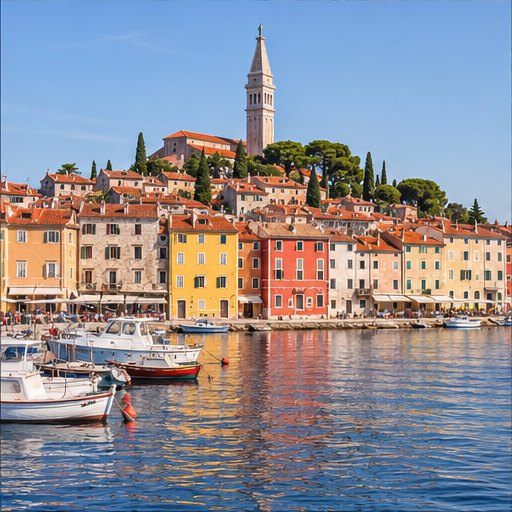
Rovinj’s old town rises from a narrow peninsula, with the church of St Euphemia visible above a close-knit field of roofs. Its scale rewards wandering between the harbor, steep lanes and sea.
Approach from the harbor, where the peninsula’s shape is easiest to understand. Boats and waterfront facades frame the old center; beyond them, lanes climb toward the Church of St Euphemia. The church and its prominent bell tower anchor the view, but the walk between harbor and hilltop is more revealing.
Take the peninsula in a simple sequence
Enter the old town by one of the streets that rise from the harbor. Lanes are narrow and often steep, with stone underfoot and little separation between public space and building entrances. Move slowly and leave room for residents. As the route climbs, turns open views back toward the sea and nearby islands. Resist following only the quickest path.
At the upper part of the old town, the church occupies the hilltop and helps explain why the settlement is legible from the water. Pause before descending by another lane. The center is compact enough for a short walk, while an unhurried visit makes time for facades, doorways and small squares.
Use the waterfront as a second perspective
The harbor promenade shows Rovinj in profile. From here, the dense roofscape and bell tower rise together, and the shoreline reveals the town’s maritime relationship. Walk away from the busiest central stretch and consider how the peninsula meets open water. The seaward edge and lane network are complementary, not competing routes.
In warm months, the waterfront can be busy and stone can hold heat. A morning or later-day walk may feel more comfortable than crossing steep lanes at midday. If swimming is part of your plan, treat it as a separate coastal activity rather than assuming the historic harbor edge is a bathing site. Use designated access points and respect local rules.
Give Istria a day beyond the coast
Rovinj can anchor a longer stay in Istria, but the peninsula is not only a line of seaside towns. Inland settlements bring a different scale: hilltop streets, agricultural surroundings and regional views. A day inland works best when you pick one or two stops and allow time to reach them. Travelers without a car should plan around available transport and confirm connections; rural routes can be less flexible than city movement.
Food is another way to notice regional character, though a meal is not a substitute for understanding the landscape. Look for menus and markets that speak to season and place rather than treating one dish as a universal Istrian experience.
Choose Rovinj for a walkable coastal base
Rovinj suits travelers who value a compact old town, harbor views and a base for exploring Istria. It may be less suitable if the goal is a large city transport network or a quiet waterfront at all hours. The old center is shared space, so wheeled luggage and steep lanes can complicate arrival; consider the topography when planning accommodation logistics.
Compare this peninsula walk with Dalmatia in Split’s palace streets and Zadar at the water’s edge. Rovinj rewards a light itinerary: harbor, hilltop, a few lanes and perhaps one inland excursion. The space between those elements gives the town its rhythm.