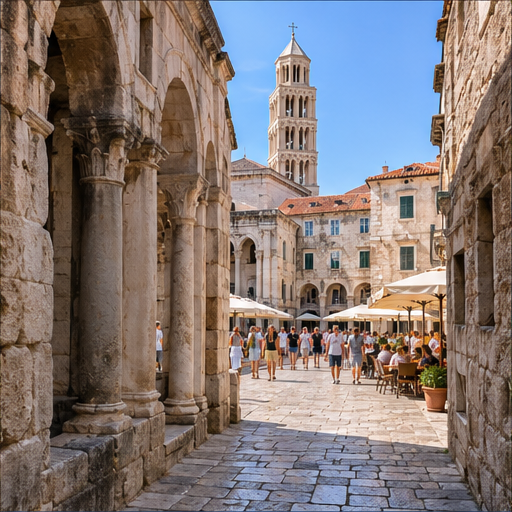
Split is not a museum district placed beside a city. Its old core grew inside the fabric of Diocletian’s Palace, so a walk moves between monumental stone and ordinary thresholds.
Start near the Riva and enter the palace through a gate that fits your approach. The waterfront side makes the structure’s scale legible; from there, lanes lead toward the Peristyle, the cathedral complex and streets beyond the old walls.
Begin where the city meets the sea
The palace was built for the Roman emperor Diocletian at the turn of the fourth century. Its form combined a residence with a fortified plan, but the living city now occupies and reshapes that inheritance. This is why the site feels less like an archaeological enclosure than a network of streets. The Riva gives the old center an open edge before you step into the dense stone fabric.
The Peristyle is a natural pause: columns and surrounding facades frame a space that has served changing ceremonial, religious and civic uses. The cathedral precinct and passage toward the Vestibule show how one short walk can cross distinct periods. Look upward at the stonework and downward at the worn paving.
Let the lanes do some of the work
Leave the busiest line for smaller alleys. They connect principal spaces with residential doorways, shops and shaded corners. Streets may be busy, and stone can be slick when wet, so comfortable shoes matter more than an optimized route. People live and work within this core; considerate movement is part of visiting well.
Continue toward the northern side to see how the monumental center gives way to streets outside the palace walls. Gregory of Nin’s statue near the Golden Gate is a useful landmark. Compare the ancient walls with later facades and the irregular openings of the lanes.
Choose a longer or shorter finish
For a compact visit, focus on the Riva, Peristyle, cathedral area and one loop of lanes. With more time, add the Archaeological Museum or climb to Marjan’s viewpoints for a wider understanding of how Split sits between hill and harbor. One extends historical context; the other changes the scale of the view.
A second day can connect the palace walk with markets and waterfront life. Keep the historic core for a cooler part of the day when possible, then use the promenade when you want air and space. For another peninsula town, see Rovinj; the Hvar island notes frame a slower extension.
Make the day useful, not overfilled
Split suits travelers who enjoy layered streets and accept that a living center will not behave like a quiet exhibit. Give yourself a loose route, a clear meeting point and time for a meal without crossing the city repeatedly. Confirm opening arrangements for interiors you especially want to see; access can vary. Decide whether your next move is inland, north along the coast or toward an island before choosing where to stay. A well-paced walk leaves you with a sense of how the city uses its past, not only a collection of photographs.