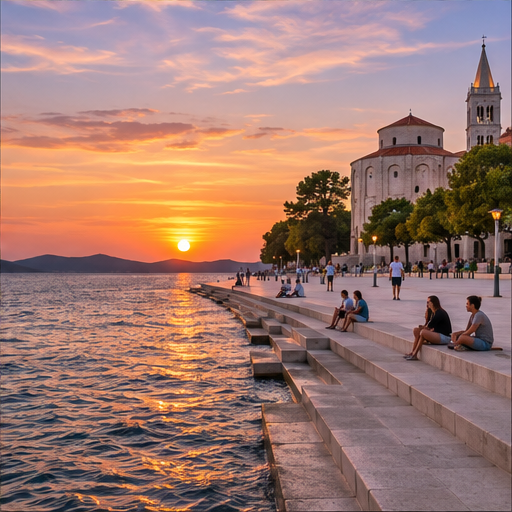
Zadar’s peninsula is compact enough to cross on foot, yet its layers ask for a slower reading. Roman street lines meet medieval churches and later squares, while the waterfront opens toward the islands.
Zadar’s historic center sits on a peninsula, making the sea a constant orientation point. Enter through the landward edge and notice how the street grid tightens around Roman-era alignments. The Forum and Church of St Donatus make a strong first pair: one reads as an open civic space, the other as a circular church reflecting successive periods.
Follow the older street lines
The Forum gives the old town a clear center, but its wider story appears between the main streets and later squares. Zadar has been shaped by multiple cultural periods; its architecture is a sequence of uses and repairs. Distinguish monumental remains from ordinary shops, courtyards and residential entrances.
St Donatus is one of the city’s recognizable buildings near Roman remains. The Cathedral of St Anastasia offers another architectural focus. Treat interiors as places with their own schedules and rules, and confirm current access if they are central to your plan. Even without entering every building, the compact distances make comparison possible on foot.
Turn west toward the Riva
The waterfront promenade changes the pace. After tighter streets, the Riva opens to the sea and islands. The Sea Organ and nearby Greeting to the Sun are public installations along this waterfront. The Sea Organ’s sound is generated by waves passing through its construction, so its effect varies with sea conditions. Treat it as a place to pause rather than a timed performance.
Stay for shifting light if your schedule permits, but do not make sunset the only reason to walk here. The Riva is also a daytime counterpoint, showing how the old town’s street pattern ends at a long public edge. Keep pathways clear and follow local guidance around installations and the sea.
Make Zadar a base or a focused stop
Zadar works well when you reserve time for both the old center and waterfront. A short visit can focus on the Forum, St Donatus and the Riva, with the cathedral as an additional stop. A longer stay can leave room for nearby coastal or island excursions, but those involve separate transport decisions and should be planned using current service information.
Travelers arriving by road should think about parking and access before entering the peninsula. Visitors using public transport should confirm station-to-center connections for the actual date. In the historic core, walking is the natural way to move between sights.
Find the right place in a north-to-south trip
Zadar offers a transition between northern and central Dalmatian stops. Pairing it with Plitvice contrasts a coastal city with freshwater landscape; our Plitvice route notes help decide how much walking to reserve. Continuing south, Split’s palace-centered streets provide another urban chapter.
Choose Zadar for an old town easy to read on foot, layered architecture and a waterfront that belongs to public life. Let the peninsula shape your route: inward through the street grid, outward to the sea, then back by another lane. That pattern gives more depth than a quick circuit of landmarks.